
 Available in US
Content
I had a Six Nations outright on France at 7/2 before the 2026 championship started. By the time they clinched the title — their 20th — the price had shortened to 6/4. That gap between pre-tournament price and closing price is the entire point of outright betting: you are paid for accepting uncertainty. The question is whether you can accept the right amount of uncertainty on the right selections.
Outright markets — also called futures — ask you to pick the winner of a tournament or competition before the final result is known. The Six Nations 2026 delivered 111 tries across 15 matches, with France taking the championship in a year when early-round results pointed in three different directions before the field thinned out. That kind of volatility is exactly what makes outright markets profitable for bettors who do the work before the first whistle.
Types of Outright Markets
The most common outright bet is tournament winner — pick the side that will lift the trophy. But the outright category extends well beyond a single winner market. Top try scorer (individual player across the tournament), Grand Slam winner (a separate market in the Six Nations, since only a side winning all five matches qualifies), top points scorer, and wooden spoon (the team finishing last) all sit under the outright umbrella.
Each market has a different risk-reward profile. Tournament winner attracts the most liquidity and the tightest odds, because it is the market every casual punter gravitates towards. Grand Slam winner carries longer odds because the additional condition (winning every match, not just finishing first) reduces the probability. In the Six Nations 2026, France won the championship but did not achieve a Grand Slam, which meant that Grand Slam backers lost even though France took the title.
Top try scorer and top points scorer markets are where the bookmaker’s pricing is often weakest. These are individual-performance markets that depend on playing time, team selection, and positional role — variables that shift across a six-week tournament and that the opening odds cannot fully anticipate. A winger who starts the first two matches but is dropped in Round 3 has his try-scoring opportunities halved, yet his pre-tournament odds were priced on the assumption of five starts.
Tournament Outright Strategy
The Six Nations is the tournament I bet on most heavily, and my approach has three stages: pre-tournament selection, in-tournament monitoring, and post-Round 3 decision.
Pre-tournament, I identify two or three sides that I believe are underpriced relative to their chances. I do not need to pick the winner; I need to pick sides whose probability of winning is higher than the odds imply. If the bookmaker prices Ireland at 3/1, they are assigning a roughly 25% implied probability. If my analysis says Ireland have a 33% chance, that is a value bet regardless of whether Ireland ultimately win. The Six Nations 2025 had 1,050,465 spectators across 15 matches, and the six-week dynamics of the championship mean that the pre-tournament favourite does not always convert form into results once the pressure of a round-by-round competition takes hold.
In-tournament, I track two things: results versus expectation, and injuries. A team that wins their first two matches by narrow margins when the bookmaker expected comfortable victories is not performing as well as the headline results suggest. Conversely, a team that loses Round 1 away from home by three points against last year’s champion may have shown enough to warrant their outright price holding or even lengthening — creating a buying opportunity.
Post-Round 3 is the decision point. By this stage, half the tournament has been played, and the field typically narrows to two or three realistic contenders. If my pre-tournament selection is still in the race, I hold. If they have been eliminated or their path requires results that now depend on other teams, I consider whether the cash-out value justifies closing the position early.
Each-Way Value in Outright Markets
Each-way betting is an often-overlooked feature of outright rugby markets. When you place an each-way bet, half your stake goes on the outright winner and half goes on your selection to “place” — typically finishing in the top two or top three, depending on the bookmaker’s terms.
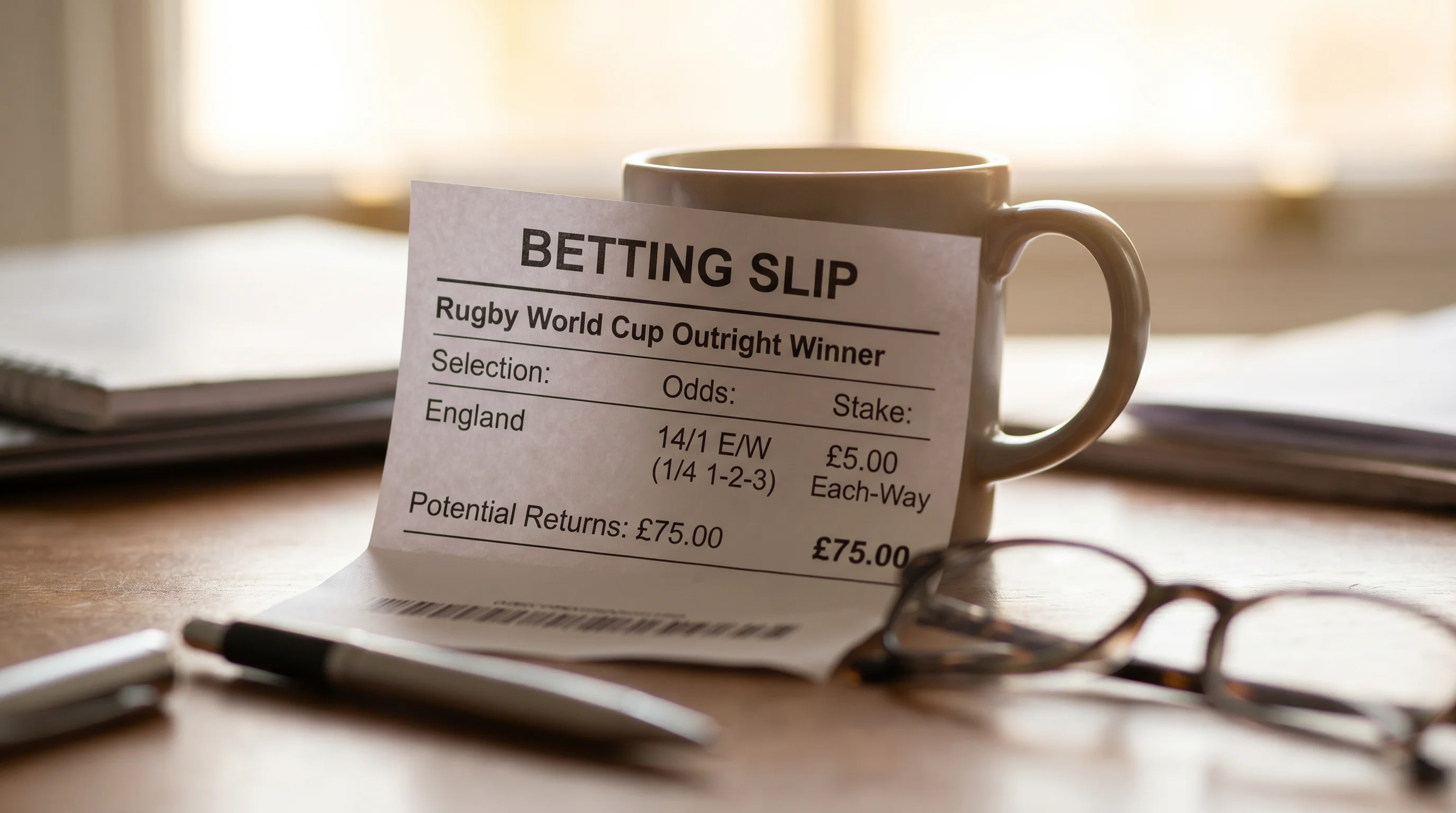
The each-way fraction (usually 1/4 or 1/5 of the outright odds) provides a safety net. If you back a team at 8/1 each-way with 1/4 odds for a top-two finish, and they finish second, the place half of your bet pays at 2/1. You lose the win half of your stake but collect on the place portion, which softens the blow significantly compared to an outright-only bet.
I use each-way most frequently for the Rugby World Cup and the Six Nations on sides priced between 5/1 and 12/1. At those odds, the place portion provides meaningful returns, and the probability of a top-two finish is high enough to make the each-way structure positive-EV even if the outright win probability is slim. On short-priced favourites (2/1 or less), each-way adds little value because the place odds are too compressed. On long shots (20/1 or higher), the place probability is usually too low to justify the additional stake.
Timing Your Futures Bets
Outright markets open months before a tournament starts, and the price moves in a predictable arc. Early prices carry the most uncertainty and therefore the most potential value, but they also expose you to the longest holding period — during which injuries, form shifts, and squad changes can undermine your selection.

The global rugby market is valued at $6.9 billion (projected $11.9 billion by 2033), and that growing commercial footprint means that outright markets attract earlier and heavier trading each year. The Six Nations outright market now opens in November, roughly three months before the first match, and the odds shorten steadily through the announcement of squads, the warm-up fixtures, and the opening round.
My timing rule: I place outright bets in two tranches. The first tranche goes on within 48 hours of the outright market opening, when the field is widest and the prices are most generous. The second tranche goes on after the final round of squad announcements, when any major injury news has been absorbed but the market has not yet fully adjusted for the confirmed starting XVs. Between those two windows, I do not touch the outright market, because the price typically moves against you without new information — just the natural tightening of odds as the tournament approaches.
Can I cash out an outright rugby bet before the tournament ends?
Most major UK sportsbooks offer cash-out on outright rugby markets, though the availability and terms vary. The cash-out value fluctuates based on the current implied probability of your selection winning — it increases after strong results and decreases after poor ones. Cashing out locks in a guaranteed return but forfeits the full payout if your selection ultimately wins. I use cash-out selectively, typically only when my selection’s chances have materially changed due to injury or a result that makes their path to the title significantly harder.
What does each-way mean on a rugby outright market?
An each-way bet splits your stake into two parts: one on the outright winner and one on a top-two or top-three finish (the place terms vary by bookmaker). If your selection wins, both halves pay out. If they finish in the place positions but do not win, only the place portion pays — at a fraction (typically 1/4 or 1/5) of the outright odds. Each-way is most useful on selections priced between 5/1 and 12/1, where the place payout is meaningful enough to offset the additional stake.
