
 Available in US
Content

I spent two seasons applying Premiership logic to Top 14 betting before I admitted the obvious: French club rugby operates on rules that barely resemble anything across the Channel. The squad depth, the travel distances, the sheer hostility of away days in Toulouse or Clermont — none of it maps onto an English framework. Once I stopped forcing it and started treating the Top 14 as its own ecosystem, my strike rate improved almost overnight.
That ecosystem is worth understanding on its own merits. The top ten national rugby unions collectively ran an operating loss of roughly $137 million in the 2023/24 cycle, yet French clubs continue to attract global talent and generate fierce domestic competition. The financial pressure creates unpredictable squad decisions, and unpredictable squad decisions create opportunity for anyone willing to dig into the details.
What Makes the Top 14 a Unique Betting Proposition
A colleague once described the Top 14 as “the Premier League with a relegation trapdoor and a 26-round marathon.” That is not a bad summary. Where the Premiership settled into a relatively compact structure, the Top 14 runs 14 teams through 26 regular-season rounds before play-offs even begin. The league stage alone stretches from September to June, producing a volume of fixtures that dwarfs most union competitions.
Scoring patterns reflect the French emphasis on forward power and tactical kicking. Matches tend to be tighter than the Six Nations average of 7.4 tries per game recorded in 2026, with Top 14 contests often producing four or five tries in total. That lower ceiling on scoring makes handicap and totals markets behave differently — you are dealing with narrow margins where a single converted try can swing an entire spread.
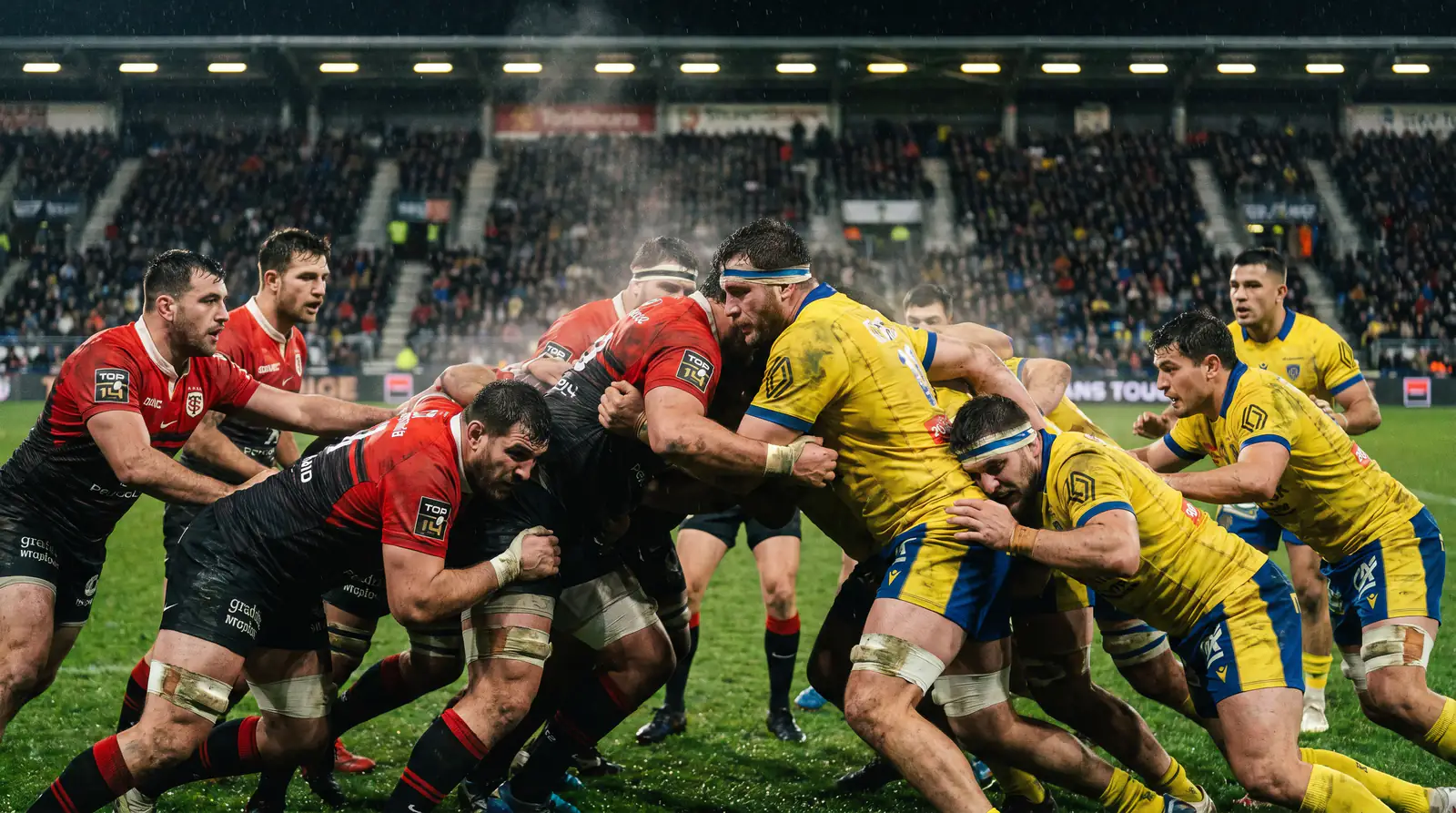
The salary cap in France, while nominally restrictive, sits higher than most other domestic leagues and allows clubs to assemble squads packed with internationals from multiple hemispheres. Toulouse alone regularly fields a starting XV drawn from four or five different national teams. That talent concentration means the gap between top and bottom is wider than casual observers assume, but it also means that international windows create wild swings in squad availability. A mid-table side losing three Springboks to the November Tests looks nothing like the team that won four straight the month before.
Squad Rotation and Its Effect on Market Prices
Here is a pattern I have tracked for years: a Top 14 coach rests his entire front row for a midweek fixture, the bookmakers barely adjust the line, and the weakened pack gets shoved backwards for eighty minutes. It happens with clockwork regularity because French coaches rotate more aggressively than their counterparts in any other major league.

The reason is straightforward survival. With 26 league rounds, European Champions Cup pool matches, and potential play-off fixtures, a first-choice squad playing every minute would be held together with tape by April. Coaches plan their rotations in blocks — heavy squad for home matches against direct rivals, development players for lower-stakes away trips. The pattern becomes legible once you track it across a few seasons.
For bettors, rotation is the single biggest edge available in Top 14 markets. Bookmakers set their opening lines based on full-strength squads, and the teamsheet released roughly 48 hours before kick-off often tells a different story. That gap between the priced squad and the actual squad creates value on both sides — you can back the opposition when a rested favourite looks thin, or you can oppose inflated lines when a so-called weakened side still fields a competitive pack. Rotation also matters enormously for rugby live betting, where the impact of fresh legs off the bench becomes apparent as the second half unfolds.
The Home Fortress Factor
I once watched Castres, a club from a town of 40,000 people, dismantle a Toulouse side stacked with internationals on a freezing Friday night. The crowd was practically on the pitch. That result surprised nobody who understood home advantage in French rugby — it is more extreme than in any other professional league I have studied.

Several factors compound to make away days brutal. Travel distances are significant: a trip from Bayonne on the Atlantic coast to Toulon on the Mediterranean is over 700 kilometres. Pitches in the south-west tend to be heavier, grounds in the Massif Central sit at altitude, and municipal stadiums in smaller cities generate noise levels that would embarrass venues twice their size. The visiting team is not just playing fifteen opponents — it is fighting geography, atmosphere, and local identity rolled into one.
Quantifying this advantage is where the edge lies. Over the last five Top 14 seasons, home win rates have consistently hovered around 60-65%, with some clubs pushing well above 70% in their own backyard. Stade Rochelais and Toulouse at home are entirely different propositions from the same squads in Paris or Lyon. When I build match previews, home or away status is the first variable I weight — before form, before squad news, before anything else. If you are new to French rugby betting, start by backing home teams at short prices and opposing away favourites at anything below -7.5. The data supports it.

Relegation Battles and Late-Season Value
Mark Oliver, chairman of Oliver and Ohlbaum Associates, put it bluntly: “Rugby just isn’t moving fast enough — competitors from UFC to F1 and cricket have innovated and left them in the rearview mirror.” That commercial stagnation hits hardest at the bottom of the Top 14, where the financial consequences of relegation to Pro D2 are devastating. Unlike the Premiership, which generates roughly GBP 320 million in annual revenue to cushion its clubs, relegated French sides lose access to the broadcasting deals and sponsorship income that keep them solvent. Some never recover.
That existential pressure transforms late-season matches involving threatened clubs into something close to cup finals. From round 20 onwards, sides fighting relegation play with a desperation that skews normal form metrics. I have seen bottom-four teams string together three or four consecutive wins in April and May, not because they suddenly improved, but because the survival instinct overrides everything else. Coaches stop rotating, directors empty the medical budget, and players treat every collision as if their mortgage depends on it — which, in some cases, it does.

The betting angle is straightforward: relegation-threatened sides at home in the final six rounds are chronically undervalued. The market still prices them based on season-long form, but season-long form is irrelevant when a club is fighting for its existence. I track a simple metric — points per game in the final six rounds for bottom-four clubs versus their season average — and the uplift is consistent enough to build a staking plan around. Combine that with the home fortress effect discussed earlier, and you have a late-season strategy that has delivered positive returns in four of the last five Top 14 campaigns for me.
Why is home advantage so pronounced in Top 14 rugby?
French clubs play in tight municipal stadiums with passionate local support, and travel distances across France are significant. Heavy pitches in the south-west and altitude in the Massif Central add physical challenges for visiting sides, pushing home win rates consistently above 60%.
How does the Top 14 relegation system affect late-season betting?
The Top 14 relegates the bottom team directly and sends the 13th-placed side into a play-off with a Pro D2 club. Financial consequences of dropping down are severe, so threatened clubs play with extreme intensity from round 20 onwards, making them consistently undervalued in late-season markets.
