
 Available in US
Content
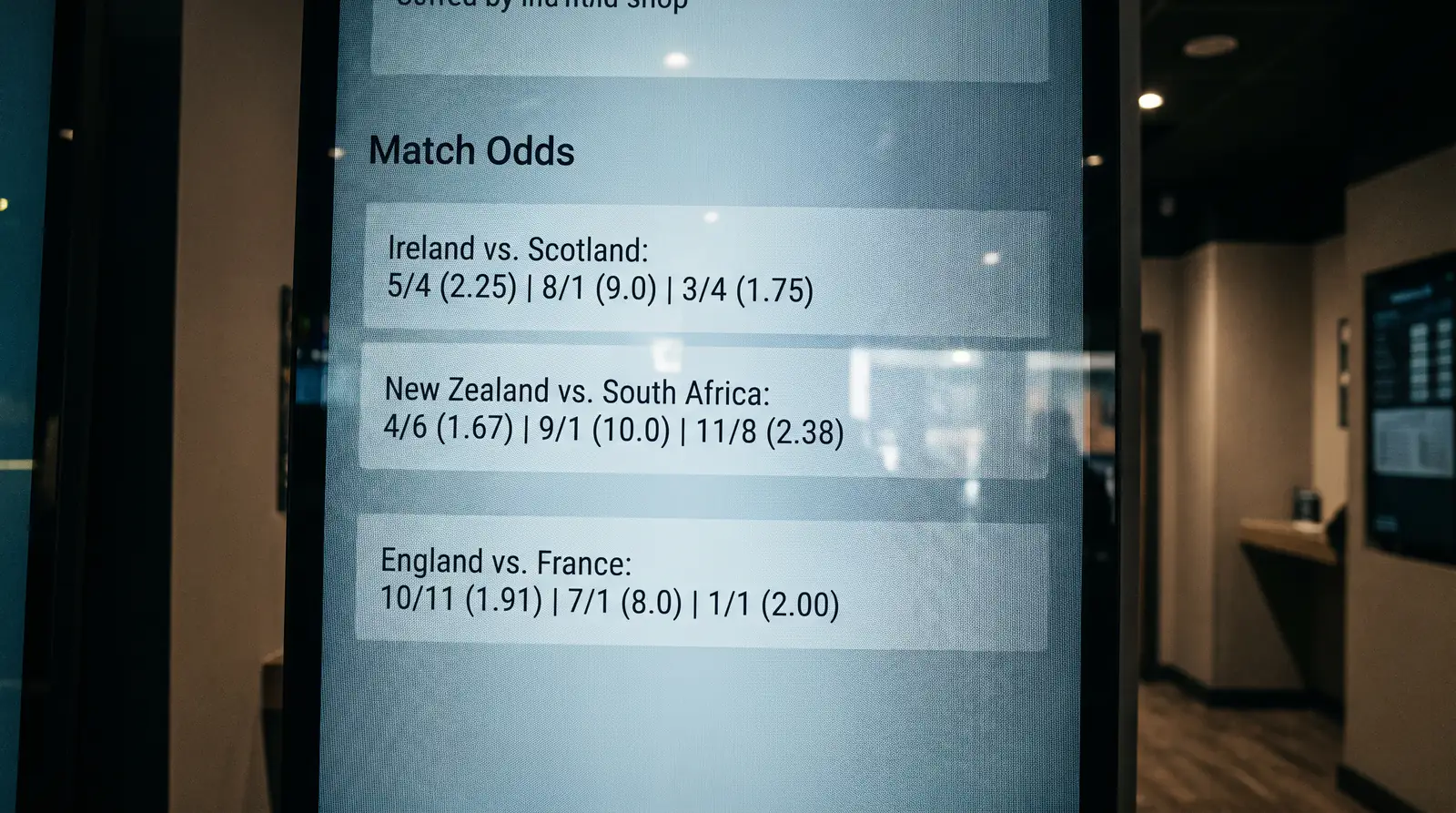
I still remember the confusion when I first saw American odds on a rugby match. The line read “-150” next to Ireland, and I genuinely had no idea whether that was good, bad, or somewhere in between. I had grown up with fractional odds — the 5/1, the 7/2, the 11/4 — because that is what British sportsbooks display by default. It took me an embarrassingly long time to realise that all three formats — fractional, decimal, American — express exactly the same information in different clothing. Once that clicked, the numbers stopped being confusing and started being transparent.
Roughly 10% of the UK adult population participates in online sports betting, and within that population, the vast majority encounter odds without ever pausing to understand what the numbers actually represent. That matters, because odds are not just a price tag. They are the bookmaker’s statement about probability, and being able to read them fluently — in any format — is the first step towards evaluating whether that statement is accurate.
Fractional Odds: The UK Standard
If you have ever walked past a bookmaker’s shop window or watched a horse race on British television, you have seen fractional odds. They look like this: 5/1, 7/2, 11/8, 4/9. The format is intuitive once you understand the structure: the first number is the profit, the second is the stake. At 5/1, a GBP 1 bet returns GBP 5 profit plus your GBP 1 stake back. At 7/2, a GBP 2 bet returns GBP 7 profit plus your GBP 2 stake.
The tricky part is that fractional odds do not show you the total return in one number. You have to add the stake mentally. This is fine for round numbers like 5/1 or 2/1, but it gets cumbersome with prices like 11/8 or 15/8. At 11/8, a GBP 8 bet returns GBP 11 profit plus GBP 8 stake = GBP 19 total. Try doing that calculation quickly while a live rugby match is in the 78th minute and the in-play odds are shifting every few seconds — it is not ideal for fast decision-making.
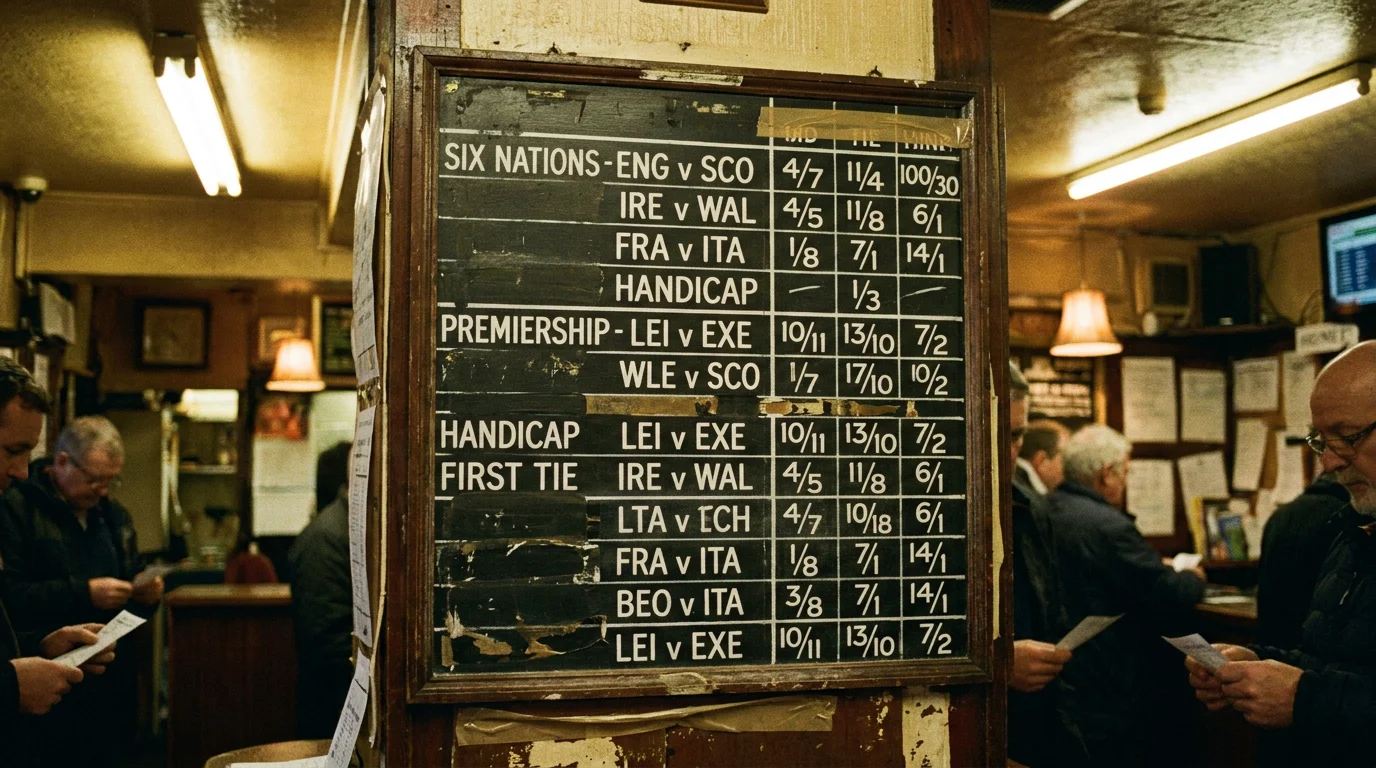
Fractional odds also obscure the relationship between favourites and underdogs when the fraction flips below 1/1. A price of 4/9 means you stake GBP 9 to win GBP 4 in profit — the denominator is larger than the numerator, signalling a strong favourite. Prices like 1/3, 2/7, or 1/10 are increasingly heavy favourites, and the mental arithmetic becomes progressively less intuitive. This is one reason why many experienced UK bettors switch to decimal format despite growing up with fractions.
For Six Nations betting, fractional odds remain the default display on most UK sportsbooks. A typical match result market might read: England 4/7, Draw 25/1, France 11/8. Those numbers are perfectly usable if you are accustomed to the format, but they require an extra cognitive step compared to decimal.
Decimal Odds: Cleaner Maths
Decimal odds show your total return per unit staked. At 3.0 decimal, a GBP 1 bet returns GBP 3 total (GBP 2 profit + GBP 1 stake). At 1.57, a GBP 1 bet returns GBP 1.57 total (GBP 0.57 profit + GBP 1 stake). The number on screen is the multiplier for your stake, and that simplicity makes decimal the preferred format for serious bettors and exchanges.

Converting between fractional and decimal takes one step: divide the first number by the second and add 1. So 5/1 becomes (5/1) + 1 = 6.0 decimal. 7/2 becomes (7/2) + 1 = 4.5. 11/8 becomes (11/8) + 1 = 2.375. In reverse, subtract 1 from the decimal and express as a fraction: 3.0 becomes 2/1, 1.5 becomes 1/2.
The real advantage of decimal odds is in accumulator calculations. Multiplying decimals is trivial: 1.8 x 2.5 x 1.5 = 6.75 combined decimal odds for a three-leg acca. Trying the same calculation in fractional format (4/5 x 6/4 x 1/2) requires converting to fractions, multiplying numerators and denominators separately, and simplifying — a process nobody should be doing on a phone while watching the final round of the Six Nations.
American Odds: The Transatlantic Format
American odds use positive and negative numbers. Positive odds (+250) show the profit on a $100 stake: at +250, a $100 bet returns $250 profit. Negative odds (-150) show how much you need to stake to win $100: at -150, a $150 stake returns $100 profit. The dividing line is +100/-100, which is equivalent to evens (1/1 fractional, 2.0 decimal).
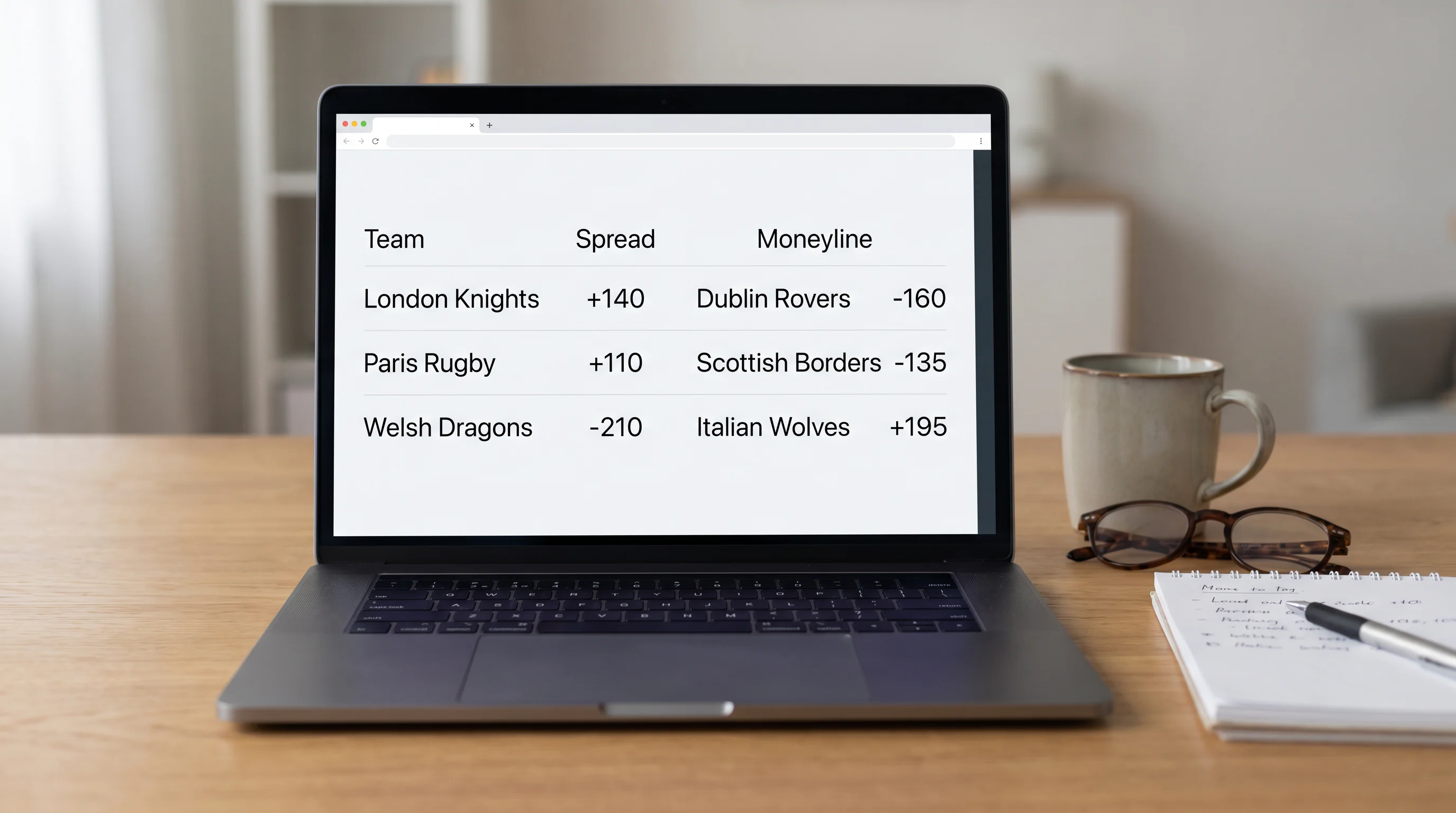
UK punters rarely encounter American odds on domestic sportsbooks, but they appear on exchange platforms, international betting sites, and in American sports media coverage of rugby events like the Rugby World Cup. If you are comparing odds across multiple platforms to find the best price — which you should be — familiarity with American format prevents misreadings. To convert American to decimal: for positive odds, divide by 100 and add 1 (so +250 = 3.5). For negative odds, divide 100 by the absolute value and add 1 (so -150 = 1.667).
Odds to Percentage: What the Numbers Mean
The practical use of understanding odds formats is converting them to implied probability — the bookmaker’s estimate of how likely an outcome is. This step is where odds stop being a price and start being a claim you can evaluate.
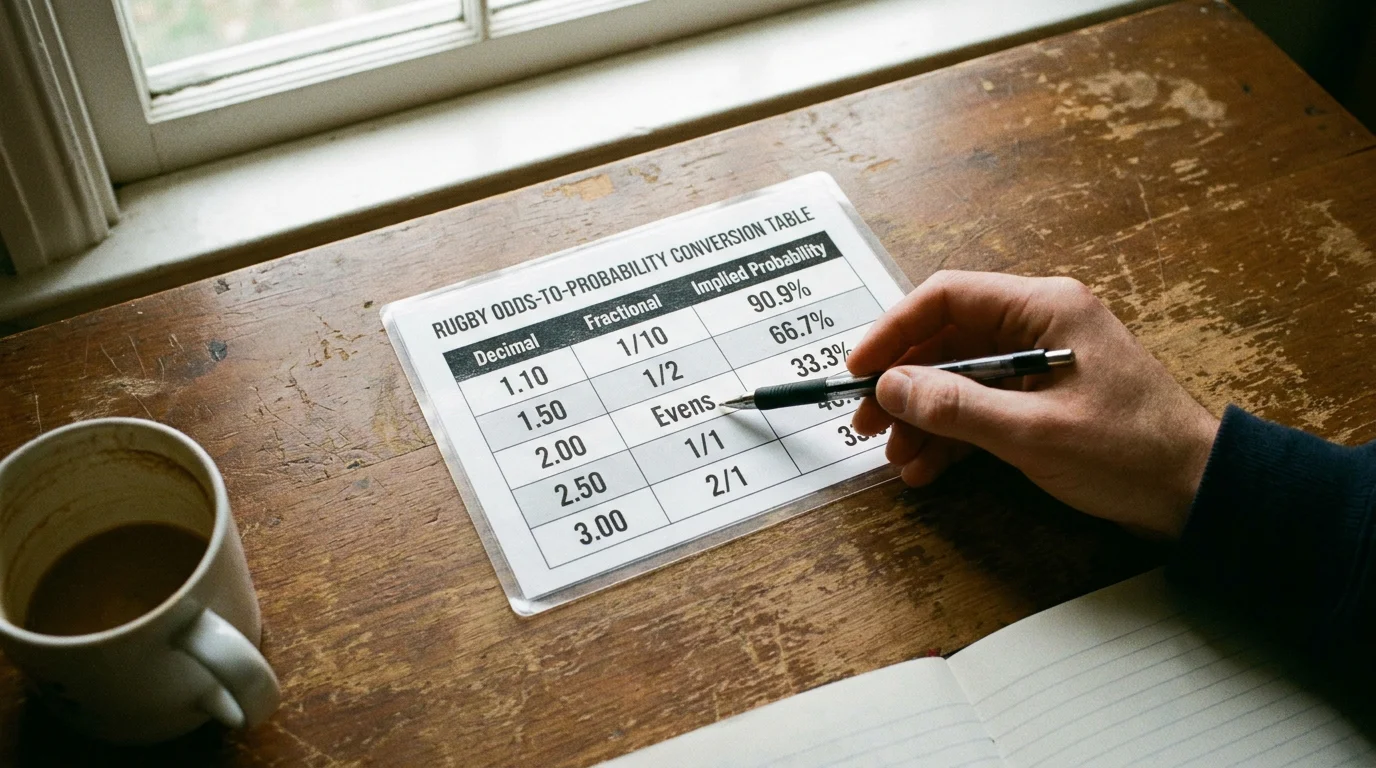
In decimal format, the conversion is: 1 / decimal odds x 100. At 3.0, the implied probability is 33.3%. At 1.5, it is 66.7%. In fractional format: denominator / (numerator + denominator) x 100. At 5/1, the implied probability is 1 / (5+1) = 16.7%. At 4/9, it is 9 / (4+9) = 69.2%.
Sports betting holds a 57.1% share of the UK online gambling market, and the vast majority of those bets are placed without the bettor ever converting the odds to probability. That gap between odds literacy and betting behaviour is one of the biggest edges available to anyone willing to do 15 seconds of arithmetic. If you know that 7/4 implies 36.4% and your analysis suggests 45%, you have identified value. If you only know that 7/4 “looks like a decent price,” you are guessing.
Which Format Fits Your Betting Style
Every UK sportsbook lets you switch between formats in settings. My recommendation: use decimal as your default. It makes return calculations, accumulator maths, and implied probability conversions faster and less error-prone. Keep fractional available for when you are scanning markets quickly (the shorthand is deeply ingrained for UK punters), and learn enough American format to compare prices on international platforms.

The format you choose does not change the bet. A GBP 10 bet at 7/2 returns GBP 45 total. The same bet at 4.5 decimal returns GBP 45 total. The same bet at +350 American returns GBP 45 total. The odds are identical; only the notation differs. What matters is fluency — being able to look at a number and immediately know the implied probability, the return, and whether the price represents value given your analysis. That fluency comes from practice, and the fastest path to practice is picking one format, using it consistently, and converting when necessary.
Which odds format do most UK rugby bookmakers use by default?
Fractional odds are the default display on the majority of UK-facing sportsbooks. However, almost every platform allows you to switch to decimal or American formats in your account settings. Decimal is increasingly popular among regular bettors because it simplifies return calculations and accumulator maths.
How do I convert fractional rugby odds to decimal?
Divide the first number by the second and add 1. For example, 5/1 becomes (5 divided by 1) + 1 = 6.0 decimal. 7/4 becomes (7 divided by 4) + 1 = 2.75 decimal. 11/8 becomes (11 divided by 8) + 1 = 2.375 decimal. To go from decimal back to fractional, subtract 1 from the decimal figure: 3.0 becomes 2/1, 1.5 becomes 1/2.
