
 Available in US
Content

The bet that changed how I think about rugby wagering was not a winner. It was a Six Nations handicap that lost by two points but that I would place again a hundred times over. The odds were 6/4, which implied a 40% probability, but my analysis gave the outcome a 52% chance of occurring. That 12-percentage-point gap is value — and value is the only thing that matters over a season of 200 or 300 bets. Individual results are noise. The edge, compounded across hundreds of wagers, is the signal.
Sports betting in the UK commands a 57.1% share of the online gambling market, making it the single largest segment. Within that market, the bettors who sustain long-term profitability are not the ones who pick the most winners — they are the ones who consistently identify prices that are too high relative to the true probability. Value betting is the method that gets you there.
Implied Probability: What Odds Really Tell You
Every set of odds contains a hidden number — the implied probability. When a bookmaker prices a team at 2/1, they are saying (before their margin) that the team has roughly a 33% chance of winning. Decimal odds make this even clearer: divide 1 by the decimal odds. At 3.0 decimal, the implied probability is 33.3%. At 1.5 decimal, it is 66.7%.

But here is the thing the bookmaker does not advertise: the implied probabilities across all outcomes in a market add up to more than 100%. If Team A is priced at 1.8 (55.6%) and Team B at 2.1 (47.6%), the total implied probability is 103.2%. That extra 3.2% is the overround — the bookmaker’s built-in profit margin. It means the odds you see are always slightly worse than the true probability, and your job as a value bettor is to find outcomes where the gap between the true probability and the implied probability is large enough to overcome the overround.
I calculate implied probability for every rugby bet I consider. The process takes 15 seconds with a calculator, and it transforms abstract numbers like “11/4” or “3.75” into a concrete question: do I believe this outcome is more likely than 26.7%? If yes, I have a potential value bet. If no, I move on. That discipline — framing every bet in terms of probability rather than potential returns — is the single most important habit in value betting.
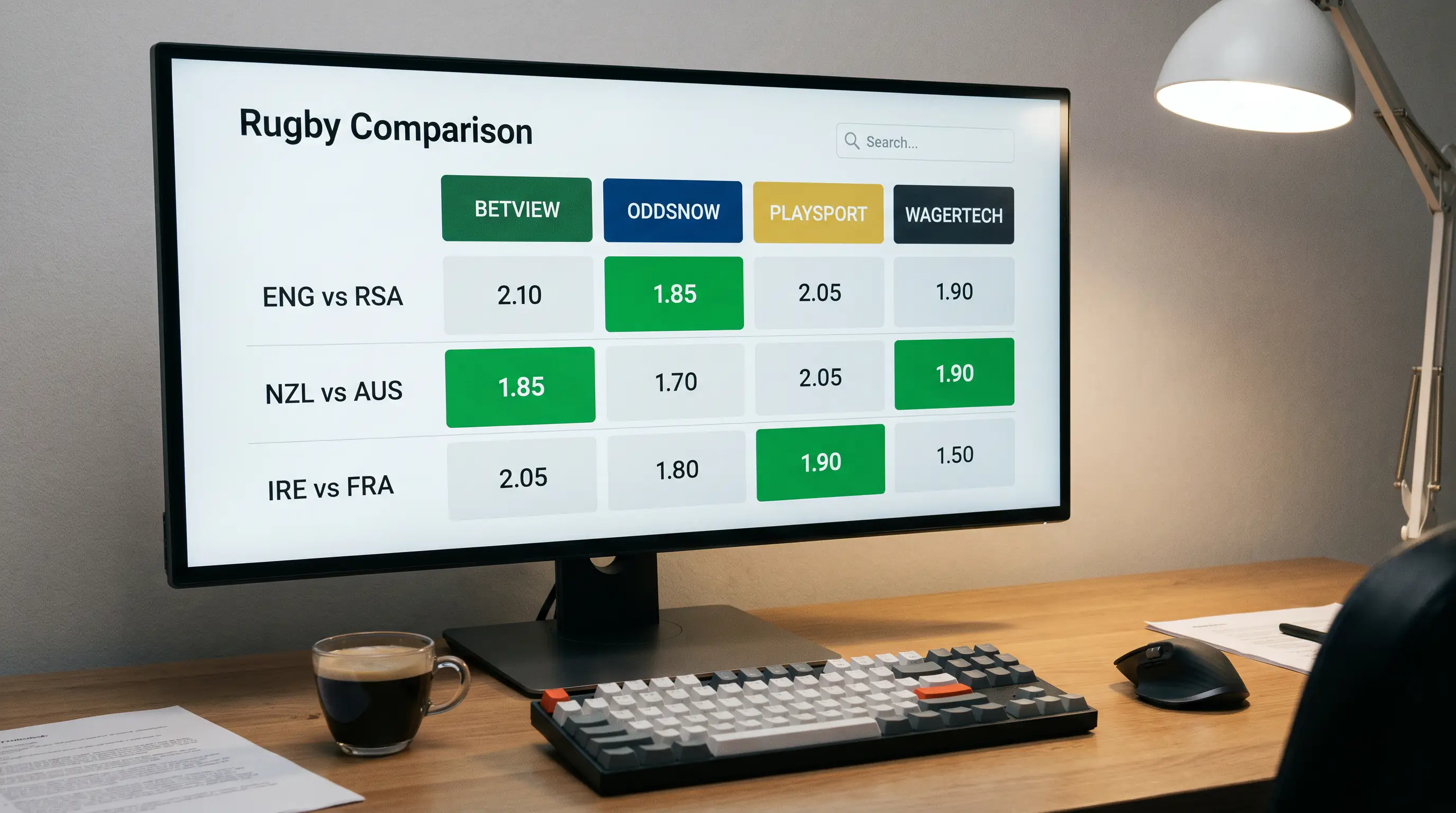
Calculating Expected Value
Expected value (EV) is the number that tells you whether a bet will be profitable over time. The formula is simple: (probability of winning x potential profit) minus (probability of losing x stake). A positive EV means the bet is profitable in the long run; a negative EV means it is not.
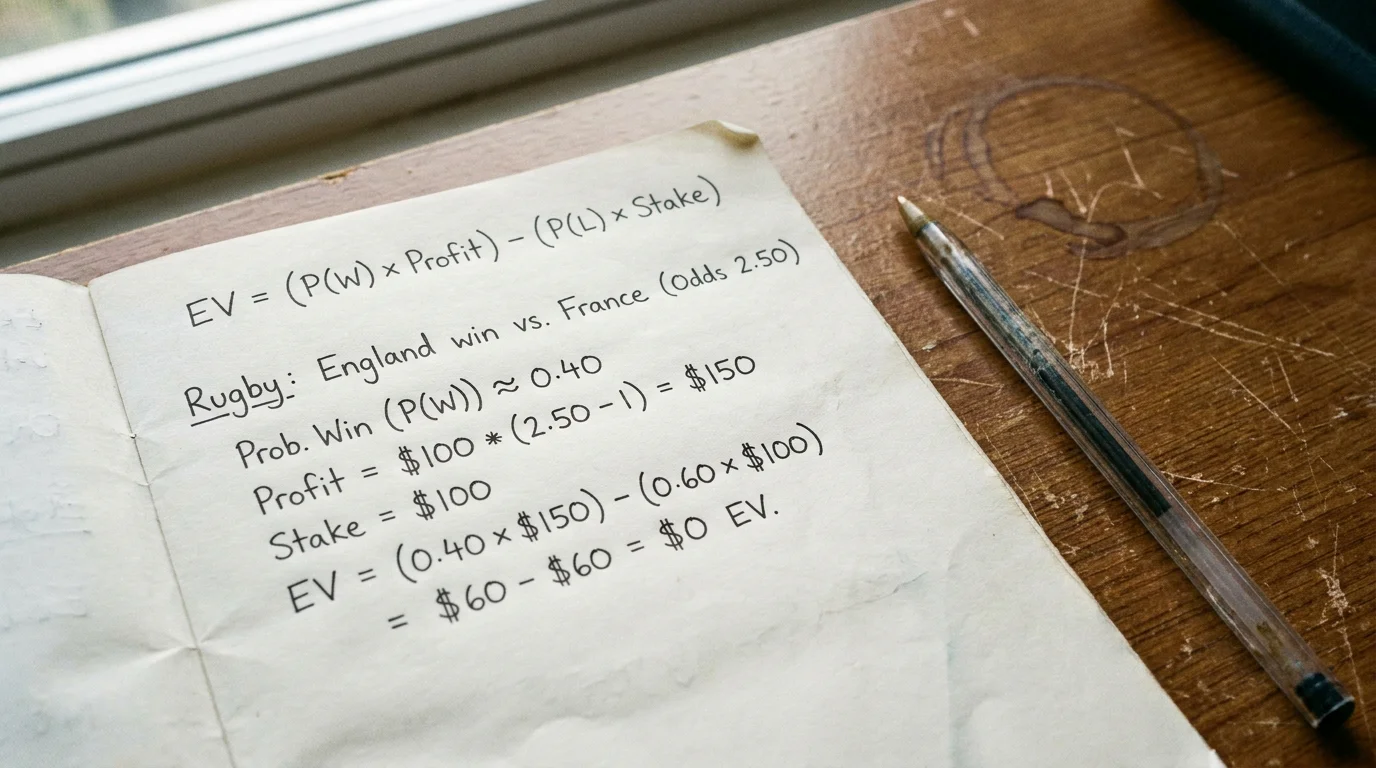
Take a concrete example. You believe a Six Nations team has a 45% chance of covering a handicap line priced at 2.0 (evens). The EV calculation: (0.45 x GBP 10) minus (0.55 x GBP 10) = GBP 4.50 minus GBP 5.50 = -GBP 1.00. Negative EV — do not bet. Now change the probability to 55% at the same price: (0.55 x GBP 10) minus (0.45 x GBP 10) = GBP 5.50 minus GBP 4.50 = +GBP 1.00. Positive EV — the bet is worth placing regardless of whether this particular wager wins or loses.
The crucial link between value identification and staking models is this: once you have identified a positive-EV bet, the size of the edge determines how much you should stake. A 2% edge warrants a smaller stake than a 10% edge, because the confidence in the probability estimate is proportional to the expected return. This is where the Kelly Criterion and other staking frameworks enter the picture.
Where Soft Markets Appear in Rugby
A “soft” market is one where the bookmaker’s price has not adjusted to reflect all available information. Soft markets exist in every sport, but rugby produces them more frequently than football or tennis for a specific structural reason: the volume of bets placed on rugby is lower, which means the market is less efficient at price discovery.
UK punters place 290 million online bets per month across all sports. Rugby’s share of that volume is a fraction of football’s, which means fewer sharp bettors are hammering rugby prices into their “correct” position. The result: opening odds on rugby fixtures often contain more value than the equivalent football market, and the odds stay soft for longer because there is less money flowing in to force corrections.

Three specific situations produce soft rugby markets consistently. The first is team news — when a key player is ruled out 48 hours before kick-off, the match result and handicap markets adjust quickly, but the try scorer, totals, and prop markets often lag behind. The second is rain — a weather forecast published four hours before kick-off that shifts the match from dry to wet conditions should suppress the over/under line by three to five points, but the adjustment frequently arrives late. The third is referee appointments, which are confirmed two to three days before the match and which influence penalty count, card, and totals markets in quantifiable ways.
Pitfalls of Value Betting in Rugby
Value betting is not risk-free, and the biggest pitfall is overestimating your own probability assessments. If you consistently assign a 55% probability to outcomes that actually occur 48% of the time, your “positive EV” bets are in fact negative EV, and you are losing money more slowly than a casual punter but losing money nonetheless.

The remedy is record-keeping. Track every bet, including the probability you assigned, the odds you took, and the outcome. After 100 bets, compare your assigned probabilities to the actual hit rate. If they match within a few percentage points, your probability model is calibrated. If they diverge by more than 5%, your model needs recalibrating before you continue staking real money.
A second pitfall: confusing value with backing underdogs. Value can exist at any price — a 1/5 favourite can be value if your analysis assigns a probability above 83%, and a 10/1 underdog can be poor value if the true probability is below 9%. The price alone tells you nothing about value; only the relationship between price and probability does. Backing underdogs because they offer bigger potential returns, without assessing whether those returns are justified by the probability, is one of the most common mistakes in rugby betting.
How do I calculate implied probability from rugby odds?
For fractional odds, divide the denominator by the sum of the numerator and denominator. At 5/2, the calculation is 2 / (5+2) = 28.6%. For decimal odds, divide 1 by the decimal figure. At 3.50, the calculation is 1 / 3.50 = 28.6%. This gives you the implied probability before the bookmaker’s margin. The actual probability of the outcome is slightly lower than the implied figure, because the overround inflates the implied probabilities across all outcomes in the market.
Is value betting the same as backing underdogs?
No. Value betting means finding odds where the implied probability is lower than the true probability, regardless of whether the selection is a favourite or an underdog. A heavy favourite at 1/4 can represent value if your analysis suggests the true probability exceeds 80%, while a 12/1 underdog can be poor value if the true probability is below 7.5%. The price and the probability are separate inputs — value exists only when the gap between them favours the bettor.
