
 Available in US
Content

November 2023 was the first Autumn series where I treated the whole window as a single betting event rather than a collection of individual matches. England hosted New Zealand, Argentina, Japan and South Africa across four consecutive Saturdays at Twickenham, and by tracking how the squad evolved, how fatigue accumulated, and how the coaching staff rotated across the month, I managed a 62% hit rate on handicap bets — my best return for any single international window. The Autumn Internationals reward a style of analysis that combines form data with tournament-level thinking, even though the fixtures are technically standalone Tests.
International rugby generates approximately $12 million in revenue per Test match, compared to just $1-2 million per match in the leading club competitions. That revenue gap explains why the autumn window attracts peak betting interest: broadcasters invest heavily, stadiums sell out, and bookmakers compile their deepest market offerings of the club season. Brett Robinson of World Rugby has spoken about rugby entering 2025 “filled with excitement” about the opportunities ahead, and the autumn window remains the sport’s most commercially intense period outside the Six Nations.
Series Format and Structure
The Autumn Nations Series (formerly the Autumn Internationals) takes place across three to four weekends in November. The home nations — England, Ireland, Scotland, Wales and France — host touring sides from the southern hemisphere (New Zealand, Australia, South Africa, Argentina) and occasionally from other Tier 1 or emerging Tier 2 nations like Fiji, Samoa, and Georgia.

Each host nation plays three or four Tests across consecutive weekends, meaning squads face significant physical demands. A player who starts all four matches in November has played 320 minutes of Test rugby in 28 days — a workload that only the Six Nations replicates. The cumulative fatigue is a critical betting factor, particularly in the third and fourth weekends, where the depth of the touring squad determines whether performance holds or drops.
Unlike the Six Nations, there is no table, no trophy, and no bonus-point system. Each match is a standalone Test, which means teams prioritise differently. A host nation might field an experimental XV in the first match to test fringe players, save their best squad for the marquee fixture (usually New Zealand or South Africa), and then rotate again for the final match if the result is less commercially significant. That prioritisation creates predictable patterns in team selection that directly affect handicap and totals markets.
Touring Team Form and Jet Lag Adjustments
Southern hemisphere teams arrive in the UK at the end of their domestic season. South African players who have been competing in the URC and Currie Cup since February are nine months into their campaign. New Zealand and Australian players wrap up Super Rugby Pacific in June and rejoin in August for The Rugby Championship. By November, the physical toll is measurable — tackle completion rates, metres carried per game, and lineout success all tend to dip in the final quarter of a long season.

TV audiences for international rugby illustrate the attention gap between competitions: a Premiership match draws 250,000-350,000 viewers, while a November Test at Twickenham might reach 3-4 million. That attention disparity means bookmakers price autumn internationals more carefully than club fixtures, but the touring team’s fatigue profile is still underweighted in the market. A side that looked dominant in The Rugby Championship in August may arrive in November carrying injuries to key players, and the replacement is not always priced accurately in the handicap line.

Jet lag is another factor that is easy to underestimate. Teams arriving from New Zealand or Australia cross 11-12 time zones, and while professional squads now arrive a week early to acclimatise, the adjustment is never complete. The first match of a tour — typically the one played at the earliest venue in the schedule — tends to see the touring side perform below their ranking-implied level. By the second or third Test, acclimatisation is complete and form normalises. This pattern creates a systematic edge on the home side in Round 1 of the autumn window.
Market Features for November Tests
Autumn International markets are among the deepest in the rugby betting calendar. Major UK sportsbooks offer 60-80 markets per match, covering match result, handicap, over/under, try scorer, first scoring method, half-time/full-time, and a range of prop markets including penalty count, card markets, and kicking totals.
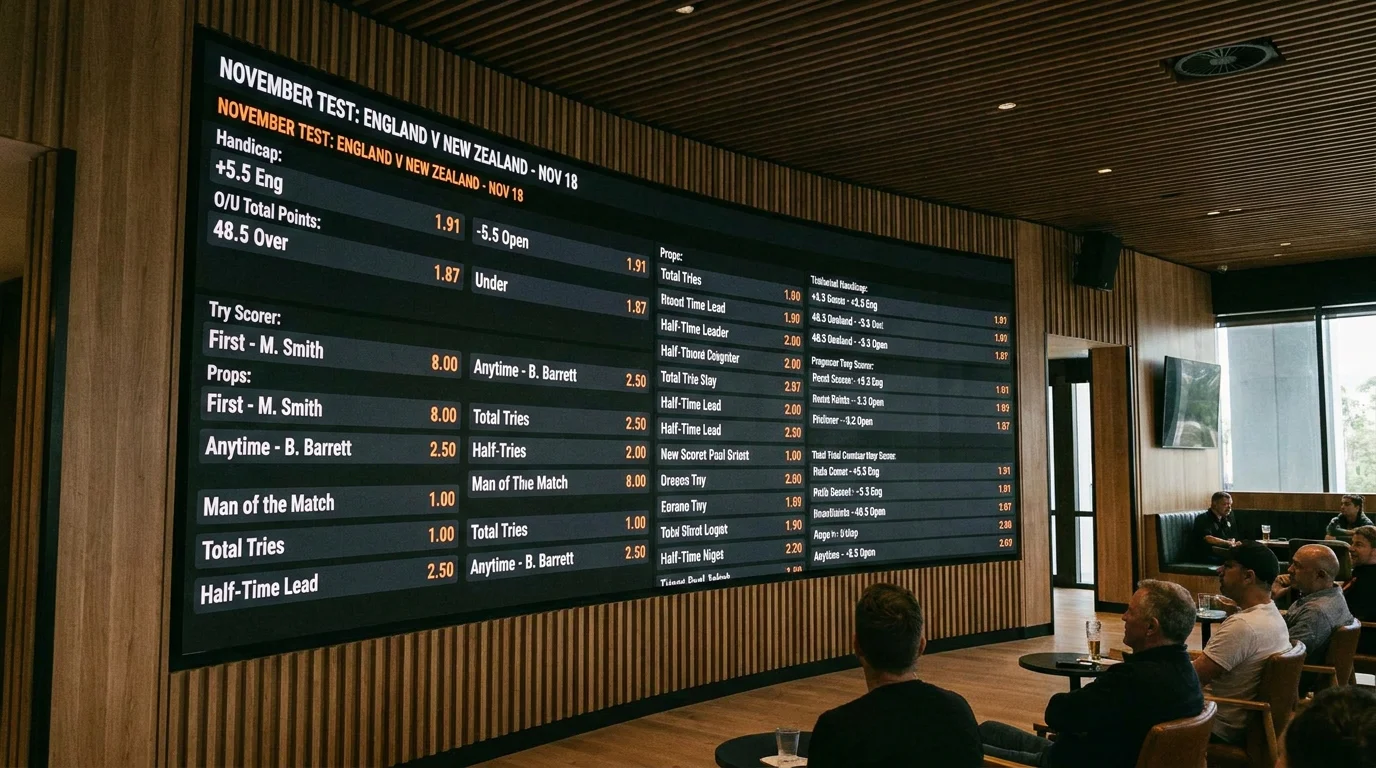
The handicap market is where I focus most of my autumn analysis. Home advantage is significant in November Tests — the home side wins roughly 60-65% of fixtures in the autumn window — but the margin varies depending on the opponent. Against Tier 1 touring sides, home margins are typically inside 10 points. Against emerging nations like Fiji or Georgia, margins can stretch to 25 or 30. The bookmaker’s handicap line usually falls between these poles, and the value sits in correctly assessing where on that spectrum a specific fixture will land.
The over/under market is affected by the transition from southern hemisphere summer rugby to northern hemisphere winter conditions. Teams that have been playing in dry, fast conditions for six months arrive in the UK to face rain, cold, and heavy pitches. Scoring typically drops compared to summer internationals, and the bookmaker’s totals line needs to account for that environmental shift. If the line is based on recent Rugby Championship scoring averages (often 45-55 points per match), the under becomes attractive for early-November fixtures played in wet conditions.
Historical Trends Worth Tracking
Over 800 million people globally express interest in rugby, but the autumn window is the one period each year when that broad interest translates into concentrated betting volume on the UK market. Three historical trends have been reliable enough to inform my approach each November.
The first: southern hemisphere teams perform below their world ranking in the first match of their November tour. The combination of travel, fatigue, and the transition to northern conditions suppresses performance by a measurable margin. This trend is strongest for sides crossing the greatest number of time zones (New Zealand, Australia) and weakest for Argentina, who cross fewer zones and have a longer history of competing in European conditions.

The second trend: scoring in November Tests is lower than in the Six Nations. The average Six Nations match in 2025 produced 55 total points. November Tests typically average 38-45 total points, reflecting the combined effect of winter conditions, touring fatigue, and the standalone nature of each fixture (there is no bonus-point incentive to keep scoring after the match is effectively won). The under is the default side for me in November, unless both teams are genuinely attack-oriented and the weather forecast is dry.
The third trend: the final weekend of the autumn window produces the most unpredictable results. By Round 3 or 4, the touring squad has acclimatised but accumulated fatigue. The home side may have rotated their squad to rest players for the club season, or they may select their strongest XV for the commercial showpiece. The tension between these competing factors creates handicap lines with the widest margin for error — and therefore the most potential value for bettors who have tracked team news across the full window.
When do betting markets open for the Autumn Internationals?
Outright markets for the autumn series typically open in late September or early October, once the fixture schedule is confirmed. Match-by-match markets open seven to ten days before each fixture, with full market depth (handicap, try scorer, props) available from the Wednesday before a Saturday match. Early prices on the first weekend often carry the most value because the bookmaker has the least current data on touring team condition.
Do southern hemisphere teams have a disadvantage in November Tests?
Statistical evidence supports a home advantage in November Tests, with the host nation winning approximately 60-65% of fixtures across recent autumn windows. The disadvantage for touring sides is driven by time-zone adjustment, the end-of-season fatigue profile, and the transition from summer to winter playing conditions. The effect is most pronounced in the first match of the tour and diminishes across subsequent weekends as acclimatisation takes hold.
