
 Available in US
Content

The worst month of my betting career was not caused by bad selections. My hit rate in March 2021 was actually above average — 56% on 25 bets. The problem was that I had staked 15% of my bankroll on a “certain” Six Nations handicap that lost, then doubled my stakes on the next three bets trying to recover. By the end of the month, a profitable selection record had produced a 30% bankroll drawdown. That experience converted me from someone who thought bankroll management was boring administrative work into someone who considers it the foundation of everything else.
In the UK, approximately 30% of adults experiencing gambling-related problems sought help in 2024 — nearly double the 17% figure from 2020. Zoë Osmond of GambleAware has noted that gambling carries risks that can erode people’s finances, careers and relationships. Bankroll management does not eliminate risk, but it creates a structure that prevents a bad run from becoming a catastrophic one. This is not optional — it is the prerequisite for sustainable betting.
Setting Your Unit Size
A “unit” is the base amount you stake on a standard bet. Every staking model starts here. The common recommendation is 1-2% of your total bankroll per bet. If your bankroll is GBP 500, one unit is GBP 5-10.
That sounds conservative, and it is meant to. The reason is variance. Even a bettor with a genuine 55% strike rate on rugby markets will experience losing streaks of five, six, seven bets in succession. If each of those bets is 10% of the bankroll, a seven-bet losing streak wipes out 70% of the funds. At 2% per bet, the same streak costs 14% — painful but recoverable. The mathematical reality is that smaller units survive longer losing streaks, and losing streaks are inevitable regardless of how good your analysis is.

I set my unit size at the start of each month based on my bankroll at that point. If the bankroll has grown, the unit grows proportionally. If it has shrunk, the unit shrinks. This automatic adjustment ensures that I am never staking an amount that my current bankroll cannot sustain through a bad run. It also removes the emotional temptation to increase stakes after a loss in an attempt to “catch up.”
Flat Staking vs Percentage Staking
Flat staking means betting the same fixed amount on every bet — one unit regardless of confidence level. Percentage staking means betting a fixed percentage of the current bankroll, which means the absolute stake rises and falls as the bankroll moves.
Flat staking is simpler and more emotionally sustainable. You know exactly what each bet costs, and you can calculate how many losing bets you can absorb before the bankroll hits a drawdown threshold. The downside is that flat staking does not account for edge size — a bet where you estimate a 10% edge receives the same stake as a bet where you estimate a 2% edge.
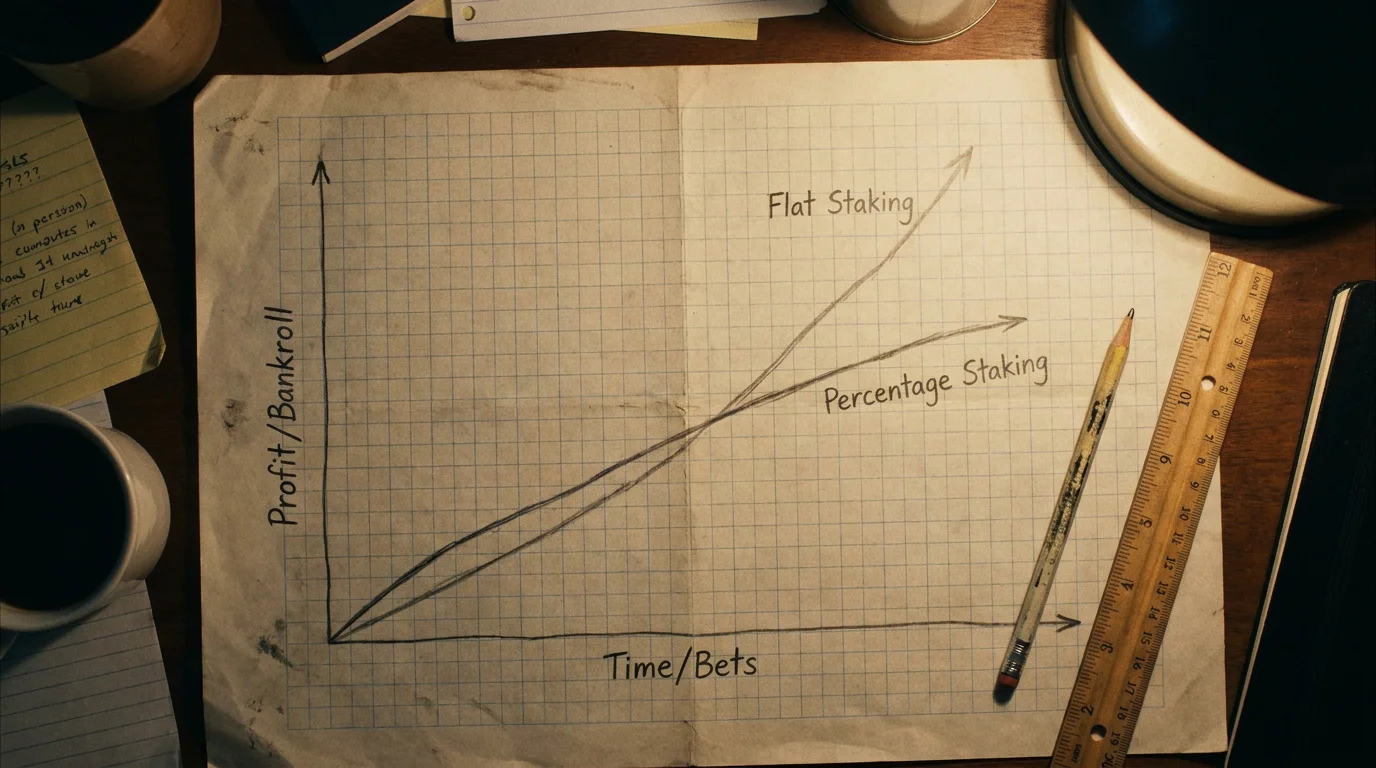
Percentage staking adjusts dynamically. If your bankroll grows from GBP 500 to GBP 700, your 2% stake increases from GBP 10 to GBP 14, which means you are compounding your gains. Equally, if the bankroll shrinks to GBP 350, your stake drops to GBP 7, which naturally limits your exposure during a downturn. The downside is psychological: watching your absolute stake shrink during a losing run can feel like you are never going to recover, even though the percentage remains constant.
My approach is a hybrid. I use flat staking as the default for standard bets and reserve percentage-based adjustments for bets where the estimated edge is above 5%. In practice, this means 80% of my bets are at one flat unit and 20% are at 1.5 or 2 units, scaled by percentage of the current bankroll.
Kelly Criterion in Practice
The Kelly Criterion is a formula that calculates the optimal stake size based on the edge and the odds. The formula is: (probability x decimal odds – 1) / (decimal odds – 1). If you believe a bet has a 55% chance of winning at decimal odds of 2.0, the Kelly stake is: (0.55 x 2.0 – 1) / (2.0 – 1) = 0.10 / 1.0 = 10% of bankroll.

Full Kelly staking is aggressive. A 10% stake on a single bet is at the outer edge of what most bettors can sustain psychologically, and the formula assumes your probability estimates are perfectly accurate — which they never are. For that reason, most professional bettors use fractional Kelly: half-Kelly (divide the calculated stake by two) or quarter-Kelly. At half-Kelly, the same bet becomes a 5% stake, which is still larger than a standard unit but survivable within a broader portfolio.
The Kelly approach links directly to value identification. Before applying the formula, you need a probability estimate that you trust, which means the Kelly Criterion only works when paired with a disciplined approach to defining your edge. If your probability estimates are poorly calibrated, Kelly will over-stake on bad bets and under-stake on good ones — the formula amplifies whatever signal (or noise) you feed into it.

I use fractional Kelly (quarter-Kelly, specifically) for my highest-conviction rugby bets — typically two or three per weekend during the Six Nations. The rest of my bets stay at the flat one-unit default. This two-tier approach captures the upside of variable staking without exposing the bankroll to the full volatility of uncapped Kelly calculations.
Emotional Guardrails
The staking model is only as strong as the discipline behind it. The NHS recorded a 34% increase in gambling disorder referrals between 2019 and 2024, and the annual cost of gambling-related harm to the health service is estimated at approximately GBP 1.2 billion. These are population-level figures, but they reflect individual decisions — including the decision to abandon a staking plan after a bad weekend.
I enforce three rules that have no mathematical basis but that protect the bankroll from the bettor (me) as much as from the market. First, I never place a bet within 30 minutes of a losing result. The emotional impulse to recover immediately produces exactly the kind of oversized, under-analysed bets that bankroll management is designed to prevent. Second, I have a weekly loss limit set at 10 units. If I hit that limit by Thursday, I do not bet again until the following Monday, regardless of how many attractive fixtures the weekend offers. Third, I review my staking log on the first of every month, checking for any pattern of escalation. If my average stake has crept above 1.2 units without a corresponding increase in average edge, I reset to flat staking for the following month.

Bankroll management is not glamorous, and nobody has ever won a bet because their staking plan was elegant. What it does is keep you in the game long enough for your analytical edge — however modest — to compound into meaningful returns. Without it, even the sharpest analysis is one bad weekend away from irrelevance.
What percentage of my bankroll should I stake on a single rugby bet?
The standard recommendation is 1-2% of your total bankroll per bet. This level ensures that a losing streak of eight to ten bets — which is statistically normal even for profitable bettors — does not cause a catastrophic drawdown. Higher-conviction bets can justify 3-5% using fractional Kelly staking, but exceeding 5% on a single bet introduces significant risk of ruin over a full season.
How does the Kelly Criterion apply to rugby betting?
The Kelly Criterion calculates the optimal stake based on your estimated probability and the available odds. The formula is (probability x decimal odds – 1) / (decimal odds – 1). Most bettors use fractional Kelly (half or quarter of the calculated stake) because the full Kelly amount assumes perfect probability calibration, which is unrealistic. It works best when paired with a disciplined record of your probability estimates and actual outcomes, so you can verify that your inputs are accurate over time.
