
 Available in US
Content

I bet on football for five years before I ever placed a wager on rugby. The transition was humbling. I assumed that my football models, my staking approach, and my market intuition would transfer cleanly. They did not. Rugby looks similar enough to football that the differences sneak up on you — and by the time you notice them, they have already cost you money.
Sports betting accounts for 57.1% of the UK’s online gambling market, and football dominates that share by a wide margin. Rugby is a smaller slice, but that smaller market has structural characteristics that create genuine opportunities for punters willing to learn the differences rather than ignore them.
Scoring Variance Changes Everything
The fundamental difference between betting on rugby and betting on football is the scoring structure. A football match typically produces two or three goals. A rugby match can produce fifty, sixty, or seventy points. That difference in scoring volume changes the statistical properties of every market you touch.

The Six Nations 2025 averaged 55 points per match, with individual fixtures ranging from tight 15-12 defensive battles to open 40-30 contests. Compare that with the Premier League, where the average match produces around 2.7 goals. The higher scoring volume in rugby means that outcomes cluster more tightly around their expected values — there is less random noise in a fifty-point match than in a two-goal match. A team expected to score 28 points might finish anywhere between 20 and 36 in a typical performance; a football team expected to score 1.5 goals might finish on zero or four.
For bettors, that reduced variance makes rugby handicap and totals markets more predictable than their football equivalents. My handicap model performs roughly 5-7 percentage points better on rugby than on football across comparable sample sizes. The trade-off is that bookmakers know this too, and rugby margins on handicap markets tend to be tighter at the top level because the pricing is more precise.
Market Depth and Liquidity
Football betting markets are oceanic. A Premier League match routinely offers 200 or more individual markets — correct score, both teams to score, corner counts, player shots, booking points, half-time result, and dozens of derivatives. Rugby markets are shallower. A typical Premiership rugby fixture might list 30-50 markets, and a mid-tier URC or Top 14 match might offer fewer than 20.

That gap in rugby betting markets is both a limitation and an opportunity. Fewer markets mean fewer ways to express an opinion, which frustrates bettors used to football’s granularity. But fewer markets also mean less competition from professional syndicates and algorithmic traders who concentrate their activity in the deepest, most liquid pools. With 290 million online bets placed monthly across the UK, the vast majority land on football. Rugby markets attract less sharp money, which means the odds can be less efficient — and less efficient odds are where value lives.
Exchange liquidity tells the same story. A Premier League match on a betting exchange might have six figures matched before kick-off; a Premiership rugby match might have five figures. Getting a meaningful bet matched on rugby exchanges requires patience, particularly for prop markets or anything beyond the match result.
The Draw Factor
Draws in football are common enough to shape every market. Roughly 25-27% of Premier League matches end in a draw, and the three-way market (home/draw/away) is the foundational bet type. Draws in rugby union are vanishingly rare — they occur in perhaps 1-2% of professional matches. That near-absence transforms the market structure.

Rugby match-winner markets are effectively two-way propositions. You are choosing between Team A and Team B, with the draw priced at long odds as a theoretical possibility rather than a realistic outcome. That simplification makes the core market easier to model — you are estimating one probability rather than three — but it also means the bookmaker’s margin has fewer places to hide. In a football three-way market, the overround can be distributed across home, draw, and away in ways that are difficult for the bettor to detect. In a two-way rugby market, the margin is more transparent.
Handicap betting in rugby serves a function similar to the Asian handicap in football: it eliminates the draw and creates a binary outcome. But because rugby scores are higher and margins of victory are wider, the handicap spread in rugby is typically larger. A -7.5 point handicap in rugby is roughly equivalent to a -1 goal handicap in football in terms of its impact on match probabilities. Understanding that conversion is essential if you are moving between the two sports.
In-Play Dynamics
Live betting on football and live betting on rugby feel like different activities. Football in-play markets respond to goals — rare, high-impact events that cause dramatic price swings. Rugby in-play markets respond to a constant stream of smaller scoring events: penalties, conversions, and tries that arrive more frequently and shift the odds incrementally rather than seismically.
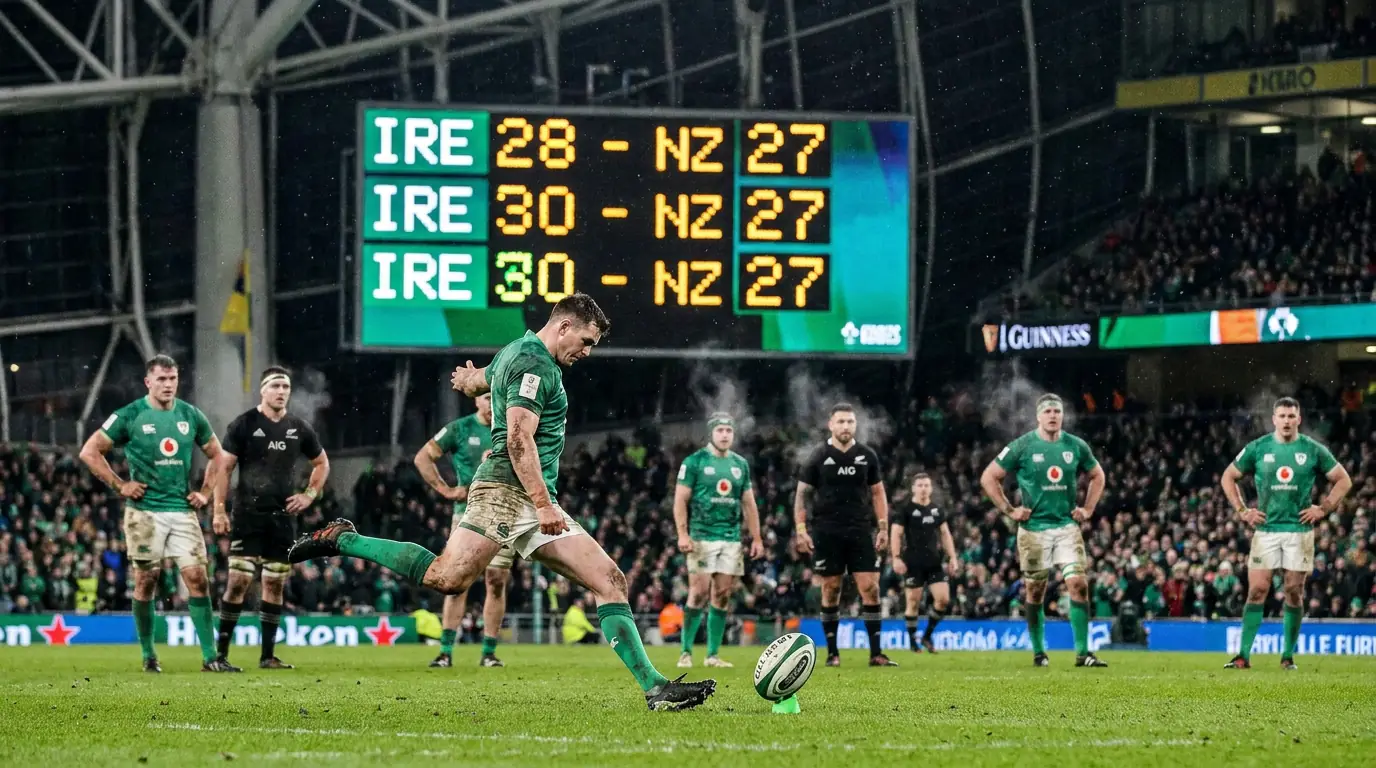
The remote betting sector generated GBP 2.12 billion in gross gambling yield in Q4 2025, and in-play wagering is a significant contributor. Rugby’s scoring cadence — a try or penalty roughly every eight to twelve minutes in a high-scoring match — creates more frequent entry points for live bettors than football’s typical 45-minute gap between goals. That frequency suits certain staking approaches, particularly those that exploit momentum shifts after a team scores.
The risk is that rugby’s continuous scoring can create a false sense of control. In football, the scarcity of goals forces patience; in rugby, the regular point-scoring can encourage overtrading. I limit myself to one in-play bet per match as a discipline, entering only when a specific trigger — a yellow card, a significant injury, a visible shift in forward dominance — creates a mispricing I can exploit.
What Transfers and What Does Not
Mark Oliver of Oliver and Ohlbaum Associates observed that rugby needs to find ways to build outside its core markets and excite the next generation. The same applies to bettors transitioning from football: you need to build new frameworks rather than assuming the old ones translate.

Bankroll management transfers perfectly. The principles of unit sizing, loss limits, and record-keeping are sport-agnostic. If you ran a 1-2% stake strategy on football, apply the same discipline to rugby. Statistical thinking transfers too — the habit of converting odds to implied probabilities, comparing them against your own estimates, and only betting when the gap exceeds the margin is exactly the same process in both sports.

What does not transfer is the intuitive feel for margins and variance. A 1-0 result in football and a 15-12 result in rugby are both tight matches, but the scoring pathways are entirely different. The global rugby market, valued at $6.9 billion in 2025 and projected to reach $11.9 billion by 2033, is growing fast enough that the betting markets around it will deepen and sharpen over time. Getting in now, while the markets are still less efficient than football, gives you a window of opportunity that will not last forever.
Are rugby betting odds generally better value than football?
Rugby markets tend to be less efficient than football because they attract less professional and algorithmic money. That creates more frequent opportunities for value, particularly in lower-profile competitions. However, the margin on high-profile rugby fixtures like the Six Nations can be comparable to top-flight football.
Can I apply football betting strategies to rugby?
Bankroll management, value identification, and statistical modelling transfer well between the two sports. Tactical analysis, scoring variance assumptions, and in-play strategies do not transfer directly because rugby’s higher scoring volume and different game structure require sport-specific frameworks.
